
Blog
Smart solutions for hospital dialysis
How can operational safety in hospitals be increased and resource efficiency improved?… ...
Healthcare provision depends on a stable infrastructure, including reliable energy and water supply. In day-to-day operations, this dependency often goes unnoticed. It is only when disruptions occur that the vulnerability of medical infrastructure becomes visible.
For years, global developments have shown that energy prices and availability are increasingly volatile. There are different reasons: regional bottlenecks, disrupted supply chains and structural dependencies overlap. Europe is affected as well. This is particularly evident in volatile electricity and heating costs, which makes long-term planning more difficult.
Dialysis is one of the most energy-intensive areas of healthcare. Rising energy prices noticeably increase cost pressure for operators. At the same time, the duty to provide care remains unchanged, regardless of market developments or external disruptions.
Unlike in some other sectors, energy consumption cannot be adjusted at short notice. Treatments cannot simply be postponed. Hygiene standards are non-negotiable.
Rising or highly fluctuating energy prices therefore affect profitability directly—and, indirectly, the security of supply.
Against this backdrop, the question becomes increasingly important: how can dialysis infrastructure be set up in a way that remains stable and manageable in the long term?
In many countries, dialysis services are reimbursed on a flat-rate basis or are tightly regulated. Rising energy costs cannot be passed on flexibly.
In its analysis of energy price developments up to 2024, the European Commission highlights that energy prices are highly volatile and that relief on wholesale markets reaches end users with a delay. These structural mechanisms are particularly relevant for energy-intensive infrastructures when new external crises emerge.
Even as the share of renewable energy increases, electricity prices remain volatile. One key reason lies in the market design: in many hours, prices are still set by the most expensive gas-fired power plant required to meet demand—the so-called marginal plant.
This means that electricity prices do not necessarily fall when large volumes of low-cost renewable energy are available. As long as gas is required to cover residual demand, it continues to set the price.
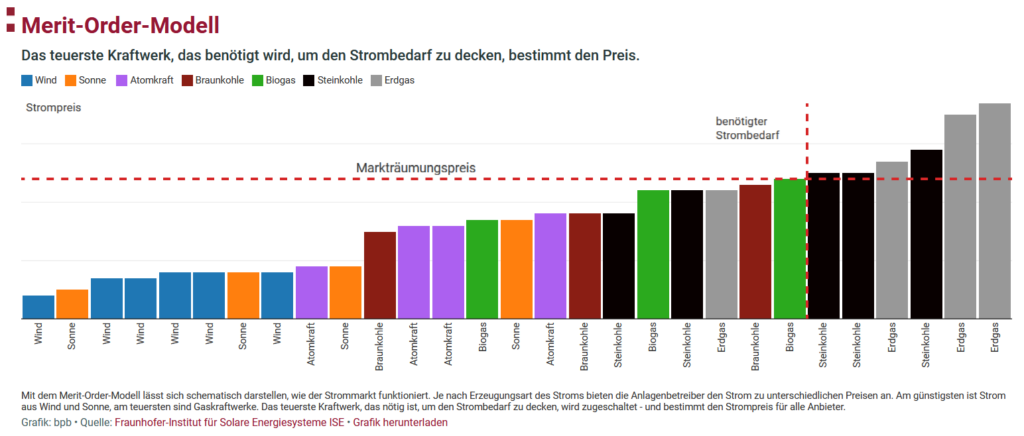 Source (unfortunately not available in English): https://www.bpb.de
Analyses by the European Commission’s Joint Research Centre (JRC) show that gas-fired power plants continue to set prices in many hours. Source: JRC
Geopolitical tensions and disruptions such as the war in Iran and the blockade of the Strait of Hormuz are driving prices up. A return to consistently low electricity prices is not currently foreseeable.
For dialysis providers, it is not only the price level that is problematic, but above all the lack of predictability.
This raises a fundamental question for dialysis centres:
How can greater planning certainty be achieved while external conditions remain unstable?
Most centres have already implemented straightforward electricity-saving measures, such as switching to LED lighting. However, many are hesitant to tackle water treatment. Replacing reverse osmosis systems only makes commercial sense when the systems have reached the end of their lifecycle, or when repair costs become uneconomical.
Nevertheless, a major opportunity lies in the technical infrastructure surrounding water treatment and the dialysis process. This is where a large share of energy consumption takes place.
Technical solutions that use energy more efficiently, smooth peak loads and stabilise systems directly contribute to security of supply.
Monitoring systems that track individual parameters and consumption make energy use actively manageable in the first place. Combined with on-site generation, for example through photovoltaic systems, it can reduce the share of grid electricity and mitigate the dependence on external price spikes.
Technical efficiency is a tool for risk reduction.
Our GreenTec Performance System (GPS), for example, continuously monitors the installed systems of the Cross-Sector Integration and water treatment. This data makes inefficient processes visible and enables optimising energy and water consumption—thereby increasing operational resilience.
Dynamic electricity tariffs are becoming increasingly relevant for electricity customers. They make price signals visible and can create incentives for load shifting. In dialysis, this is only possible to a limited extent because treatments cannot be flexibly rescheduled.
The contribution of dynamic tariffs to resilience therefore lies less in short-term savings. What matters is the combination of tariff structure, intelligent control and—where possible—storage and on-site generation:
Dynamic electricity tariffs can also be relevant for dialysis centres that do not have the option to install a PV system.
Whether a dynamic electricity tariff is worthwhile must be assessed on a case-by-case basis and depends on several factors (e.g. load profiles, number of treatments, technical options, and monitoring systems). There is no one-size-fits-all solution.
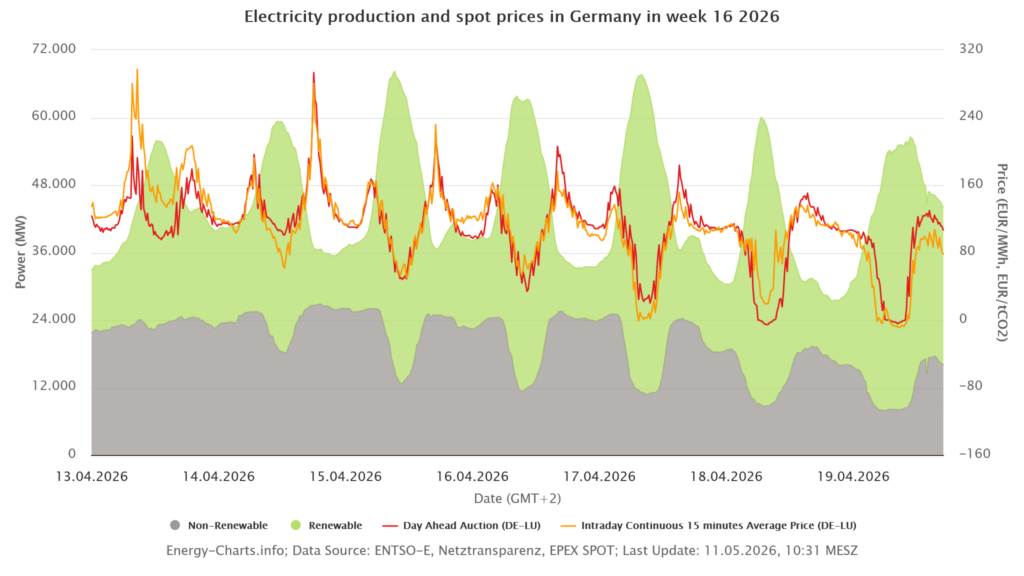
Source: https://energy-charts.info
For dialysis, energy is a strategic risk factor. Price volatility hits the sector disproportionately due to its high energy demand. Security of supply, economic viability, and sustainability are closely interconnected.
Operators who address this early and optimize their processes increase their resilience and will be better prepared when the next crisis hits.
Or, more bluntly: those who do not actively manage energy are leaving a key business risk exposed to external developments.
How can operational safety in hospitals be increased and resource efficiency improved?… ...
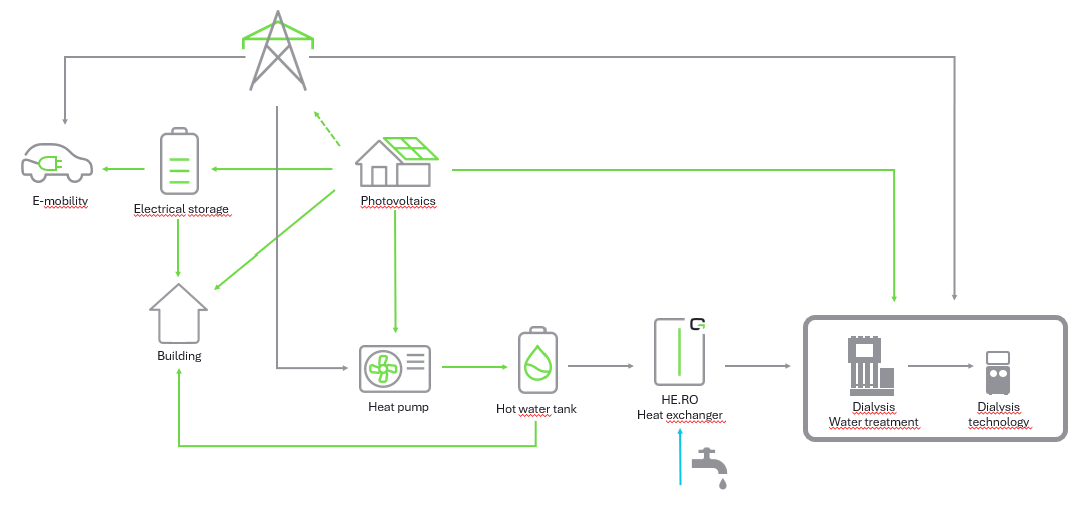
Cross-sector Integration in dialysis saves up to 50 % of electricity and can save significant amounts of water. This reduces operating costs and saves valuable resources. A win-win situation for providers, patients and the environment. ...

As part of the construction of the new clinic dialysis unit, we were awarded the contract to design and implement our Smart Dialysis solution. ...



You need to load content from hCaptcha to submit the form. Please note that doing so will share data with third-party providers.
More InformationYou need to load content from reCAPTCHA to submit the form. Please note that doing so will share data with third-party providers.
More InformationYou need to load content from Turnstile to submit the form. Please note that doing so will share data with third-party providers.
More Information